
Two packaging quotations can show similar unit prices while covering different work: one supplies flat blanks for your team to assemble; the other includes inserts and assembly. A foil finish that dominates a rendering may attract little attention when someone uses the pack. Choosing materials and finishes means considering protection, handling and the full purchasing conditions together, rather than asking whether one finish is expensive.
Start by specifying what the packaging must do. Ask suppliers to quote for the same product, quantity and delivery conditions, then examine corresponding samples. The same material name does not guarantee the same thickness, structure, surface treatment or production conditions. A rendering cannot demonstrate handling, transport performance or production consistency.
Identify essential spending through real use
Follow the actual product through packing, storage, transport, display, opening, use and storage after opening. At each stage, ask where damage or difficulty could occur and what the customer actually touches or sees.
For products used over several occasions, consider opening and closing, replacing the remaining contents and storage. Gift combinations also need checks of carrying, opening and the order in which products are revealed. Structures that protect, identify or help people use the product have a clear purpose. Decoration added mainly to enrich a rendering still needs an explanation of its value in use before you approve the spending.
Food contact, barrier performance, moisture resistance and load-bearing requirements must be assessed by the relevant materials, manufacturing or technical specialists against the actual product conditions. Designers can state objectives and identify observed problems. Feel alone cannot establish material compliance, and photographs of an empty box cannot confirm transport performance with the product inside.
Align quotation conditions before comparing prices
A comparable enquiry should state the product dimensions and weight, structural and material requirements, actual order quantity, number of variants, lead time and delivery format. Mark undecided items as awaiting confirmation. Do not enter an unapproved large order just to obtain a lower unit price.
| Part of the quotation | Questions to clarify |
|---|---|
| Fixed costs | Which cutting dies, printing plates or tools are required, and can they be reused? |
| Per-unit costs | Are material, printing, surface finishes, inserts and assembly included? |
| Order conditions | What quantity, variant count, lead time, transport, tax basis and validity period apply? |
| Use and storage | What are the finished volume, delivery format, assembly labour and storage requirements? |
Even at the same total quantity, producing several small variants can require a different arrangement from using one structure with different labels. The manufacturer should quote for the actual alternatives; there is no universal percentage to apply.
A larger quantity may spread fixed costs across more units, but can also increase the total payment, required storage space and risk that printed information becomes outdated. If product specifications may still change, or the packaging carries a seasonal theme, include the treatment of unused stock in the purchasing decision. A cheaper unit price does not automatically make the order less costly overall.
Use “fixed costs + per-unit cost × actual quantity + other costs such as assembly and transport” to organise the total cost of this order. Check which items are already included so they are not counted twice. An enquiry sheet does not replace a formal quotation, but can reveal omissions: a low price may exclude assembly, while a higher price may include the protective insert this order needs.
Make the trade-offs concrete
The following is a hypothetical review of an everyday tea gift pack. It is not a client record, measured result or market quotation.
| Comparison | Option A | Option B | What to verify next |
|---|---|---|---|
| Visual emphasis | Several surface finishes | One main finish retained | Whether recognition remains clear at a small size |
| Opening and use | Inner layer obstructs the small packs | Opening allows easier access | Remove and replace the actual contents |
| Delivery format | Flat blanks; assembly quoted separately | Assembled packs; insert included | Requote total cost on the same basis |
| Surface durability | Material undecided | Material undecided | Compare corresponding samples for handling marks |
Do not conclude that B is better simply because it is simpler. First check whether removing finishes affects recognition, then compare access and purchasing conditions. If A protects fragile contents while B lacks necessary protection, visual simplification is not a sufficient reason to choose B.
Likewise, break “better quality” into specific areas: touch, edge finishing, printing detail or opening. Explain what needs to improve so the manufacturer can supply a relevant material or process sample instead of simply adding decoration.
Connect sample approval to production conditions
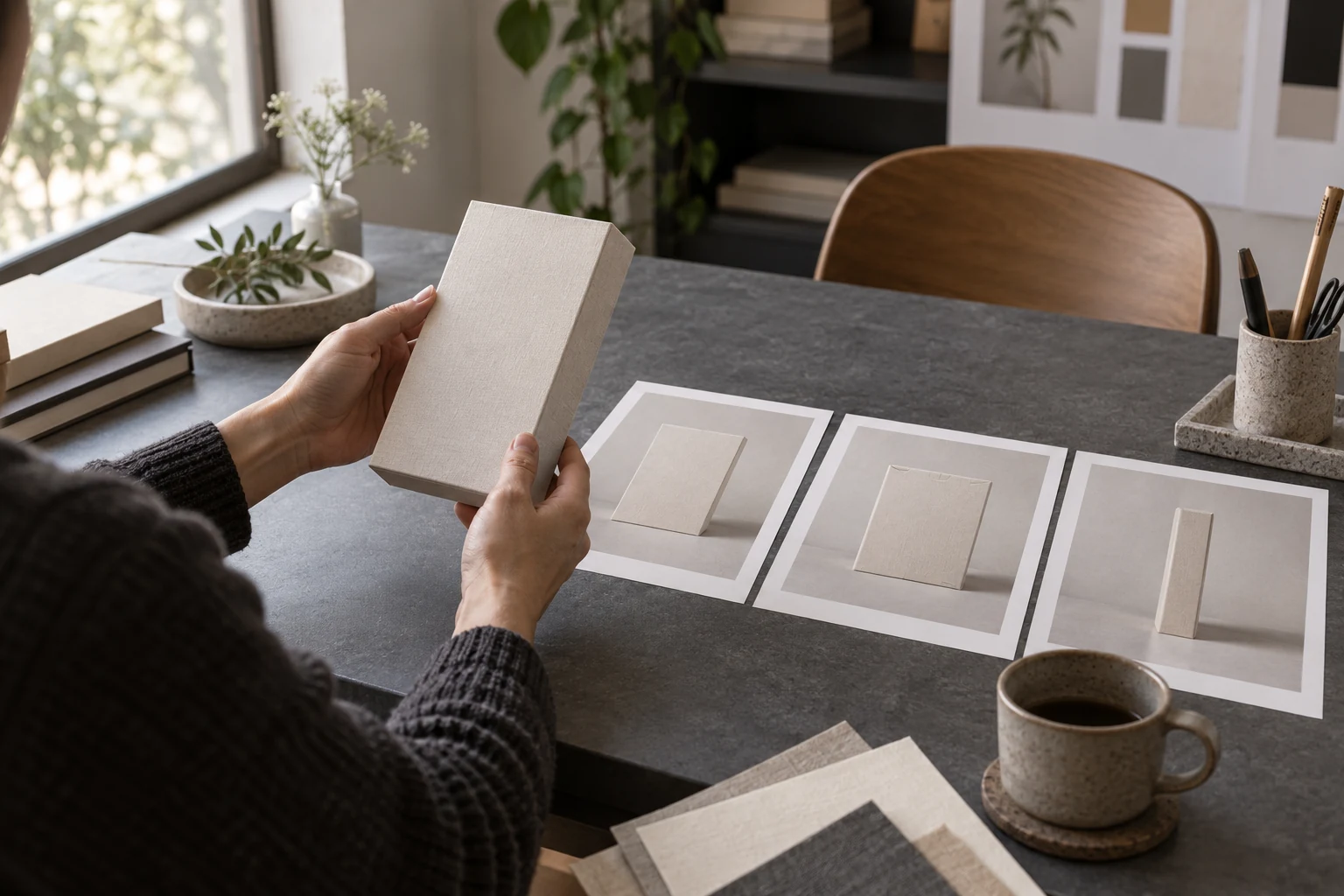
A handmade sample can help check proportions, opening and information placement. It may not represent production printing colours, assembly efficiency or consistency. Record its material, structure, finishes and method of manufacture. Ask the manufacturer which conditions will carry into production and which still require checking.
Record sample problems as “location — user action — observation — proposed change — person confirming”. For example: “At the opening, the small pack catches when removed; manufacturer to check dimensions and assembly clearances.” This is more actionable than “the insert is awkward”. Record only what was tested. Do not approve unexamined moisture or transport requirements alongside the sample's appearance.
The business confirms product facts and mandatory information, the manufacturer confirms structural and process conditions, and the designer confirms layout and files. If a material changes, recheck the affected colour, structure and presentation. Unaffected parts can retain their previous approval; every change need not reopen the entire design.
Keep a record of the decision
In ZHAMORE's brand loop, product facts guide communication, actual samples support acceptance, and use feedback returns to the current information and design. Retain the chosen material sample, process description, quotation conditions, approved files and reasons for the trade-offs. When reducing costs or changing supplier later, you can identify what needs another check.
Choose the most disputed finish first. State the experience it is meant to improve and ask the supplier for a quotation on matched conditions and a corresponding sample. Once its purpose is clear, decide whether to retain, simplify or replace it. Confirm the respective scope of packaging design, sampling and printing as agreed; one successful sample is not a guarantee of production performance.